
Key Takeaways
The optical interconnect market within AI data centers reached approximately $3.75 billion in 2025 and is projected to grow to $18.36 billion by 2033, a compound annual growth rate (CAGR) of nearly 22%.1
The Big Four hyperscalers: Amazon, Google, Microsoft, and Meta, collectively plan to spend up to $725 billion in capital expenditure in 2026, a 77% increase from 2025, the majority directed at AI infrastructure.2
Co-Packaged Optics (CPO), the next generation of optical integration, is projected to exceed $20 billion in market value by 2036, growing at a CAGR of approximately 37%.3
Over 80% of data center links within hyperscale environments already rely on optical interconnects rather than traditional copper cabling, reflecting the scale of adoption already under way.
The GPU Cluster Problem
Training a large AI model requires thousands of GPUs operating in concert. NVIDIA’s latest Blackwell Ultra platforms, ramping across US hyperscalers throughout 2025, can link tens of thousands of GPUs together, each needing to exchange data with its neighbours at extraordinary speed. The communication bandwidth required between chips has grown exponentially, far outpacing the capacity of traditional copper interconnects.
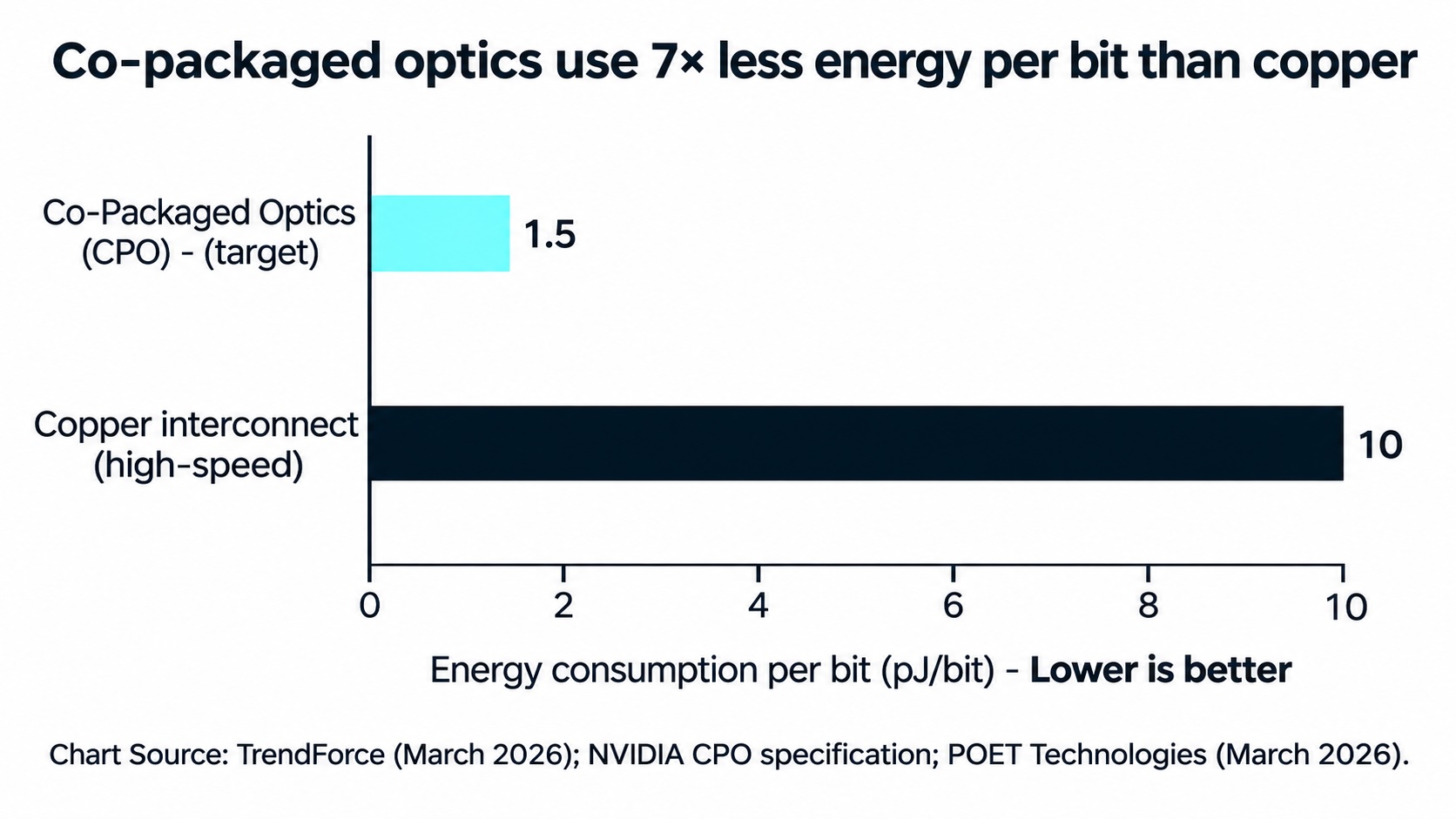
Copper wiring, which has served data centres well for decades, has three fundamental weaknesses at AI scale: it generates significant heat, it suffers from signal degradation over distances greater than a few metres, and its energy consumption per bit transmitted is orders of magnitude higher than optical alternatives. At the scale of a modern hyperscaler, clusters consuming tens of megawatts of power, these inefficiencies are not minor inconveniences4,5,6
According to Dell’O’ro Group, worldwide data center capital expenditure increased 43% in the second quarter of 2025 alone, driven by the ramp of NVIDIA Blackwell Ultra platforms. Accelerated server spending rose 76% year-on-year during that period.7
Why Silicon Cannot Simply Emit Light
Here lies the core scientific challenge and the structural investment opportunity. Silicon is an “indirect bandgap” semiconductor, meaning its crystalline structure makes it fundamentally inefficient at converting electrical signals into photons. You cannot build a practical laser from pure silicon. This is not an engineering limitation that more transistors or better fabrication can overcome; it is written into the physics of the material itself.
The solution requires entirely different materials, compounds such as Indium Phosphide (InP) and Gallium Arsenide (GaAs), which are “direct bandgap” semiconductors capable of efficiently emitting coherent light. These exotic chemistries form the foundational layer of the AI photonics value chain, and the companies that master their production and integration are positioned at a critical chokepoint in the AI infrastructure buildout. Unlike the semiconductor fabs that produce silicon chips, InP fabrication is concentrated among a small number of specialist manufacturers globally, creating meaningful barriers to entry. Coherent Corp. (NYSE: COHR) illustrates the opportunity: the company operates the world’s first 6-inch Indium Phosphide wafer production lines at facilities in Sherman, Texas, and Järfalla, Sweden, and has secured a supply agreement with NVIDIA for CW lasers used in co-packaged optics architectures.8
$725 Billion Catalyst
The scale of the capital deployment now flowing into AI infrastructure is historically unprecedented. Google, Amazon, Microsoft, and Meta collectively plan a $725 billion of capital expenditure (capex) in 2026, a 77% increase from the record $410 billion spent in 2025. A significant majority of that spending is directed at AI-optimised data centre facilities that require dense optical interconnect fabric.2
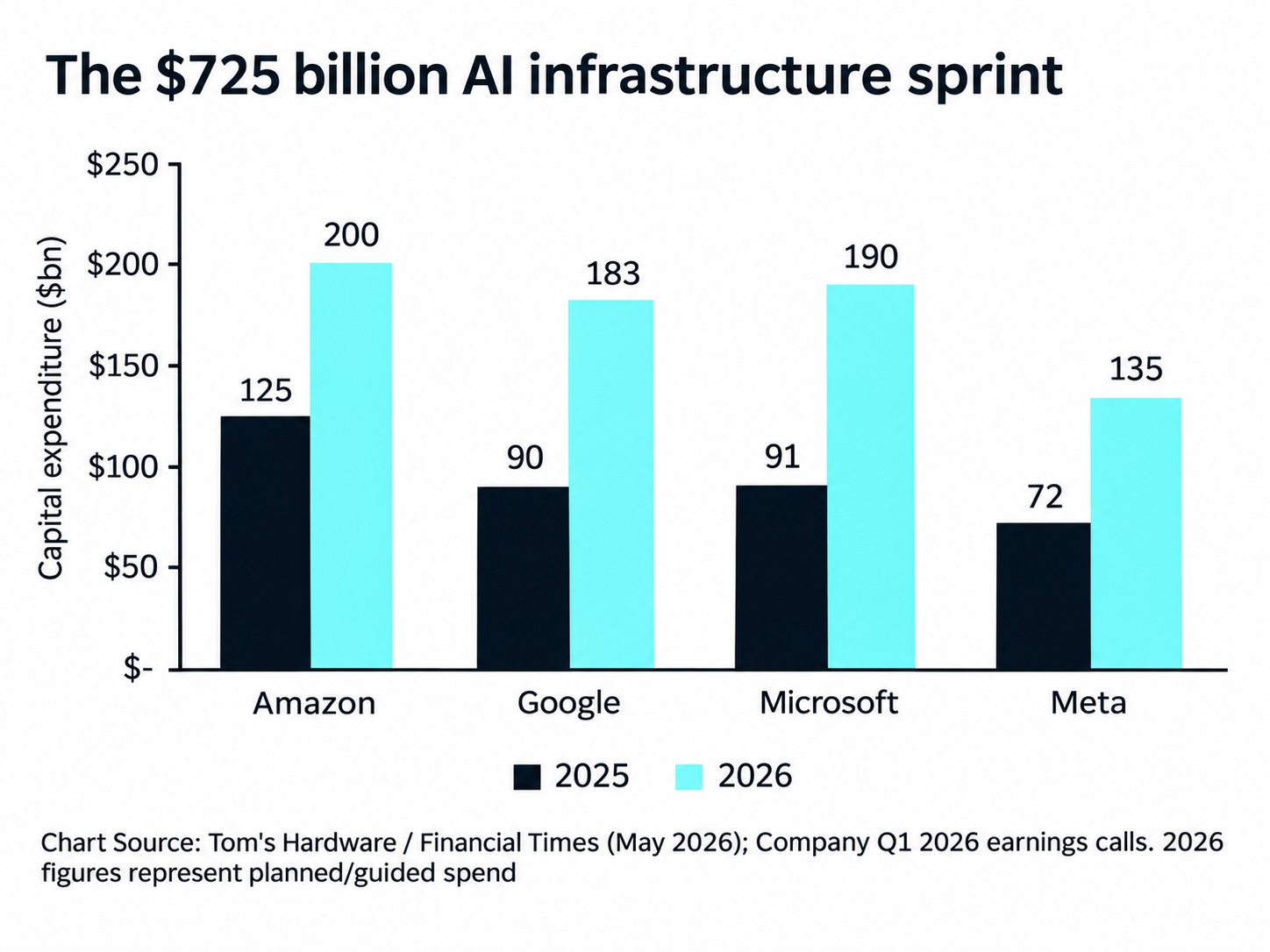
Microsoft alone set its calendar-year 2026 capital expenditure at $190 billion, while Alphabet guided to a matching figure. Amazon, the largest spender, projecting $200 billion. These are not soft targets: Goldman Sachs projects total hyperscaler capital expenditure from 2025 to 2027 at $1.15 trillion, more than double the $477 billion spent from 2022 to 2024.9
Each of these facilities requires high-density optical interconnect fabric connecting GPU clusters, switches, and storage systems. The optical transceiver and interconnect market sits directly in the path of this capital cycle. As AI clusters scale from hundreds to tens of thousands of accelerator nodes, optical connectivity ceases to be optional equipment, it becomes load-bearing infrastructure.
The Optical Interconnect Market: Scale and Growth
The optical interconnect market specifically serving AI data centers reached approximately $3.75 billion in 2025 and is projected to expand to $18.36 billion by 2033, representing a compound annual growth rate of approximately 22%. The broader optical interconnect market across all applications was valued at approximately $16 to $18 billion in 2024 and is projected to reach $34 to $41 billion by 2030.1
The market for optical transceivers serving AI clusters, covering the scale-out and scale-up networks that connect GPU nodes, is expected to more than double in two years, growing from approximately $5 billion in 2024 to over $10 billion in 2026, according to LightCounting, a specialist optical market research firm.10
Optical transceivers currently represent the largest product segment, accounting for approximately 27% of market revenue, and the adoption of silicon photonics, which integrates optical functionality directly onto silicon chips is forecast to grow at among the fastest rates within the sector, at approximately 13% CAGR through 2035.11
Co-Packaged Optics: The Next Generation
The leading edge of this transition is Co-Packaged Optics (CPO), a technology that integrates optical components directly alongside the compute chip on the same package, eliminating the electrical signal path between processor and transceiver entirely. In March 2024, Broadcom introduced the first 51.2 Tbps CPO switch, integrating eight silicon photonics engines with its Tomahawk 5 ASIC and achieving approximately 70% lower power consumption compared with pluggable transceivers. By January 2026, Broadcom had confirmed shipment of more than 50,000 Tomahawk 5 CPO switches during 2025 and previewed a 200G-per-lane third-generation platform.12
NVIDIA signalled its full commitment to CPO at GTC 2025 with the introduction of Spectrum-X Photonics and Quantum-X Photonics networking platforms, both built on co-packaged optics. In April 2026, NVIDIA and Marvell Technology expanded their strategic collaboration through NVLink Fusion, advancing silicon photonics for scalable AI infrastructure. According to IDTechEx, the CPO market is projected to exceed $20 billion by 2036, growing at a CAGR of approximately 37% from 2026.3
CPO demands extraordinary precision in assembly and entirely new approaches to chip packaging. The companies capable of robotically assembling lasers, photodetectors, and Optical DSPs into production-ready CPO modules at scale represent some of the most defensible competitive positions in the sector. Unlike software, these manufacturing capabilities take years to develop and cannot be replicated overnight by a well-funded competitor.
A Value Chain Without a Weak Link
AI photonics is not a single-product market. It encompasses six distinct layers of the value chain: exotic raw materials such as Indium Phosphide; the lasers and lenses that generate and direct light; the Optical DSP chips that bridge electrical and optical worlds; the assembly houses that combine those components into finished modules; the Ethernet switches and fibre infrastructure that form the physical network; and the testing and measurement equipment that validates performance before deployment.
The most important insight for investors may be this: a bottleneck at any single layer constrains the entire chain. The industry experienced this directly in 2023 and 2024, when shortages of specific optical components created data centre deployment delays despite ample availability of GPUs. An approach that covers the full value chain is better positioned to capture sector growth while managing the supply-chain volatility that is an inherent feature of a rapidly scaling industry.13
The Investment Case
AI photonics is not a derivative bet on which large language model wins the market. It is a structural infrastructure play on the physical constraints of computation itself. Regardless of whether the leading AI application layer is dominated by a US, European, or Chinese provider, every serious AI training cluster in the world requires optical interconnects to function at scale.
The sector also benefits from a characteristic that differs from many technology themes: long procurement visibility. Once a hyperscaler designs its cluster architecture around a specific optical interconnect specification, 400G, 800G, or the emerging 1.6T standard, that specification drives multi-year purchasing cycles. Component suppliers embedded in those architectures benefit from demand visibility analogous to the backlog structures seen in defence contracting.
The photonics analogy to a picks-and-shovels play is apt but perhaps undersells the point. Optical interconnects are not optional equipment for the AI buildout. They are the physical infrastructure without which the AI compute cycle cannot proceed.
Conclusion
The strategic case for AI photonics investment rests on three structural factors:
The physical impossibility of scaling AI compute clusters without optical interconnects
An unprecedented hyperscaler capital expenditure cycle measured in hundreds of billions of dollars annually
A six-layer value chain with multiple points of entry across different risk and return profiles
For investors, understanding these structural drivers helps explain why exposure to the AI photonics sector is increasingly viewed as a long-term thematic allocation, one tied not to a single product cycle, but to the fundamental architecture of how computation itself is being built.
Investors should consider the investment objectives, risks, charges, and expenses carefully before investing. For a prospectus or summary prospectus containing this and other information about the Fund, please call (888) 824-4467 or visit www.aura-etfs.com. Please read the prospectus or summary prospectus carefully before investing.
Investments involve risk, including the possible loss of principal.
Foreside Fund Services, LLC, distributor.
Sources
DataM Intelligence — Optical Interconnect in AI Data Centers Market (2026): https://www.datamintelligence.com/research-report/optical-interconnect-in-ai-data-centers-market
Tom’s Hardware / Financial Times — Google, Microsoft, Meta, and Amazon capex spending to hit $725 billion in 2026 (May 2026): https://www.tomshardware.com/tech-industry/big-tech/big-techs-ai-spending-plans-reach-725-billion
IDTechEx — Co-Packaged Optics (CPO) 2026–2036: Technologies, Market, and Forecasts: https://www.idtechex.com/en/research-report/co-packaged-optics-cpo/1138
TrendForce — Micro LED CPOs Cut Power Consumption to 5% of Copper Cables (March 2026): https://www.trendforce.com/presscenter/news/20260304-12947.html
Inneos — Optics vs Copper: Debunking Myths and Understanding the Real Benefits: https://www.inneos.com/optics-vs-copper/
POET Technologies — AI Data Center Photonics: Why Light Is Replacing Copper (March 2026): https://www.poet-technologies.com/blog/ai-data-center-photonics-why-light-is-replacing-copper
Dell’Oro Group — Hyperscaler AI Deployments Lift Data Center Capex to Record Highs in Q2 2025 (September 2025): https://www.delloro.com/news/hyperscaler-ai-deployments-lift-data-center-capex-to-record-highs-in-2q-2025/
Coherent Corp. — World’s First 6-Inch InP Wafer Fabs and NVIDIA Supply Agreement: https://www.coherent.com/news/press-releases/worlds-first-6-inch-inp-scalable-wafer-fabs-paving-the-way-for-the-next-generation-of-lasers-for-ai-transceivers-and-6g-wireless-networks
Introl / IEEE ComSoc — Hyperscaler capex exceeds $600bn in 2026, a 36% increase over 2025: https://introl.com/blog/hyperscaler-capex-600b-2026-ai-infrastructure-debt-january-2026
LightCounting — Optics for AI Clusters (January 2025): https://www.lightcounting.com/newsletter/en/january-2025-optics-for-ai-clusters-319
SNS Insider — Optical Interconnect Market Size, Growth & Trends 2025–2035: https://www.snsinsider.com/reports/optical-interconnect-market-7668
Mordor Intelligence — Co-Packaged Optics Market: Broadcom Tomahawk 5 Shipment Data (March 2026): https://www.mordorintelligence.com/industry-reports/co-packaged-optics-market
McKinsey & Company — Opportunities in Networking Optics: Boosting Supply for Data Centers (July 2025): https://www.mckinsey.com/industries/technology-media-and-telecommunications/our-insights/opportunities-in-networking-optics-boosting-supply-for-data-centers