
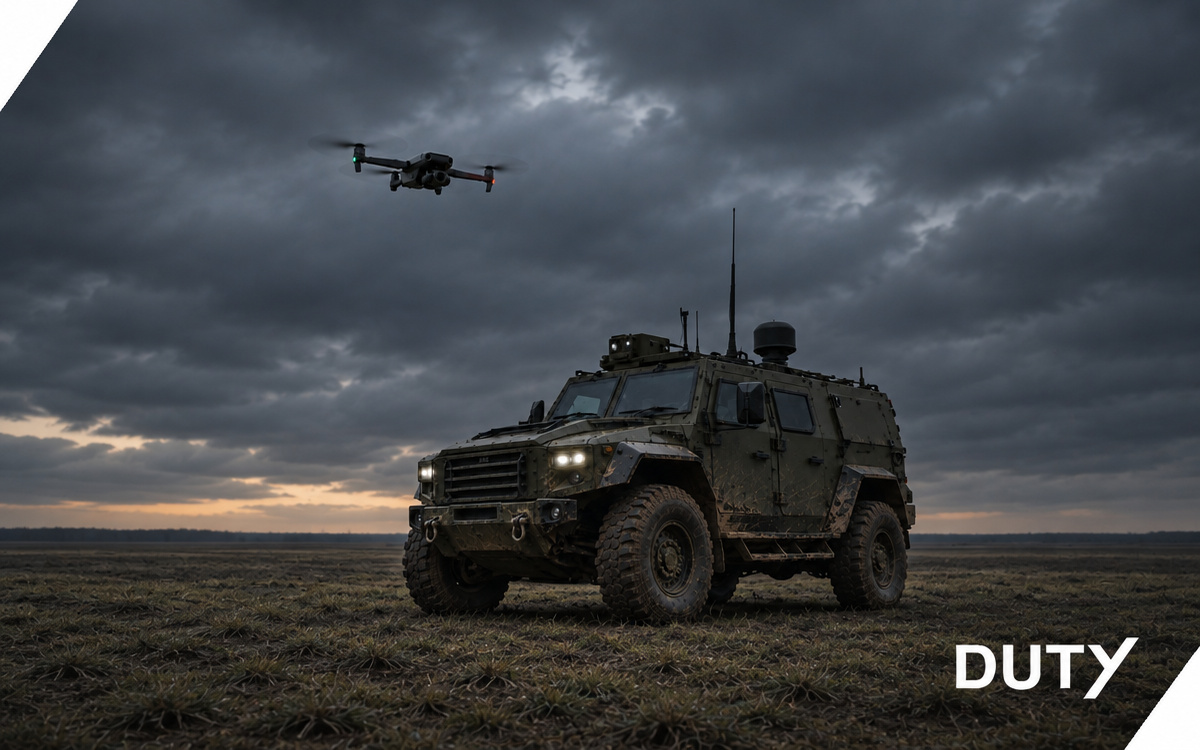
Defense is evolving from a hardware-focused industry into a technology ecosystem spanning artificial intelligence, cyber defense, space infrastructure, and autonomous systems.
Defense innovation is increasingly policy-led, not purely market-led: Many breakthrough technologies still need early funding, testing, and adoption before commercial demand exists. Defense budgets can play that role, especially in areas like AI, autonomous systems, cyber, space, and secure communications.
Modernization is changing what “defense exposure” means: Aircraft, ships, missiles, and vehicles remain central, but future capability increasingly depends on the systems connecting them. Data, software, sensors, logistics, cyber resilience, and interoperability are becoming part of the core investment story.
A broader ecosystem may better reflect the next defense cycle: Prime contractors remain important, but the opportunity set now extends into suppliers, software firms, cybersecurity providers, space infrastructure, and nontraditional vendors. That makes the case for looking beyond single-company exposure.
Innovation is often associated with Silicon Valley startups and venture capital funding Yet many of the technologies that underpin modern life trace their origins to a different source: government defense spending. Historically, it has served as one of the world's largest funding engines for innovation.
For example, the internet emerged from the U.S. Department of Defense's ARPANET program. GPS was originally developed for military navigation before becoming a core component of smartphones, logistics networks, ride-sharing applications, and precision agriculture.1 Satellite communications followed a similar path, evolving from strategic military capabilities into infrastructure that supports everything from television broadcasting to global broadband networks.2
Defense is often an early adopter of emerging technologies because national security priorities can justify investment years before commercial demand exists. Governments frequently fund research, testing, and deployment at scales that would be difficult for private industry to support on its own. As technologies mature, many eventually find applications in the civilian economy.
Today, defense spending is increasingly shifting away from purely platform-centric procurement toward software, data, connectivity, and integrated systems. Aircraft, ships, and armored vehicles remain important, but modern military effectiveness increasingly depends on the ability to collect information, process it quickly, communicate across networks, and coordinate operations across multiple domains.
This shift is often described as multi-domain operations, where military activities are integrated across land, sea, air, space, and cyberspace. Rather than viewing each domain independently, defense organizations are investing in technologies that connect and enhance them, such as artificial intelligence, cloud computing, autonomous systems, satellite networks, electronic warfare, and cybersecurity.3
For investors, this evolution broadens the investable universe considerably. Understanding defense through this lens shifts the conversation beyond military procurement cycles alone. It becomes a discussion about how governments fund innovation, how emerging technologies are commercialized, and how national security priorities can influence the development of entire industries.
Defense Spending Is Becoming a Technology Roadmap
The U.S. remains the largest defense spender in the world, and that makes its budget more than a domestic policy document. It sets the direction for the global defense industry, especially in areas where U.S. procurement priorities influence allied spending and contractor investment
What stands out in recent budget priorities is the shift from simply expanding force size toward modernizing the tools used to project power. The emphasis is increasingly on technological superiority, resilient supply chains, and capabilities that can operate across more contested environments.
That means defense spending is moving toward areas such as advanced weapons systems, missile defense, naval capabilities, cybersecurity, space infrastructure, and the domestic industrial base.4
The Department of Defense’s FY2026 budget materials include $205.2 billion for procurement and $384.3 billion across procurement and related weapon system acquisition costs, while senior defense officials also highlighted $6.5 billion for conventional and non-hypersonic munitions, $3.9 billion for hypersonic weapons, $15.1 billion for cybersecurity, $1.3 billion for industrial base supply chain improvements, and $2.5 billion for missile and munitions production expansion.5
The Indo-Pacific remains a central focus. The FY2025 request emphasized deterrence in the region, including missile-defense activities for Guam, cyber operations, autonomous systems, and technologies that can operate across all domains. FY2026 materials continue that direction, including programs designed to accelerate procurement of emerging capabilities from small businesses and nontraditional defense contractors.6
This is where the budget becomes relevant for investors. Defense procurement is often multi-year in nature, especially for major platforms, munitions, ships, space systems, and digital infrastructure. That can create longer-term revenue visibility for companies tied to funded programs. It can also support a broader ecosystem of suppliers, software firms, cybersecurity providers, and industrial base companies that sit below the prime contractor layer. 7 This direction is not limited to the U.S.
NATO allies committed at the 2025 Hague Summit to invest 5% of GDP annually on core defense requirements and defense- and security-related spending by 2035, including 3.5% for core defense and 1.5% for related areas such as infrastructure, resilience, innovation, and industrial development. The European Commission’s ReArm Europe Plan, also called Readiness 2030, aims to mobilize more than €800 billion in defense spending, including the €150 billion SAFE loan instrument for joint procurement.8,9
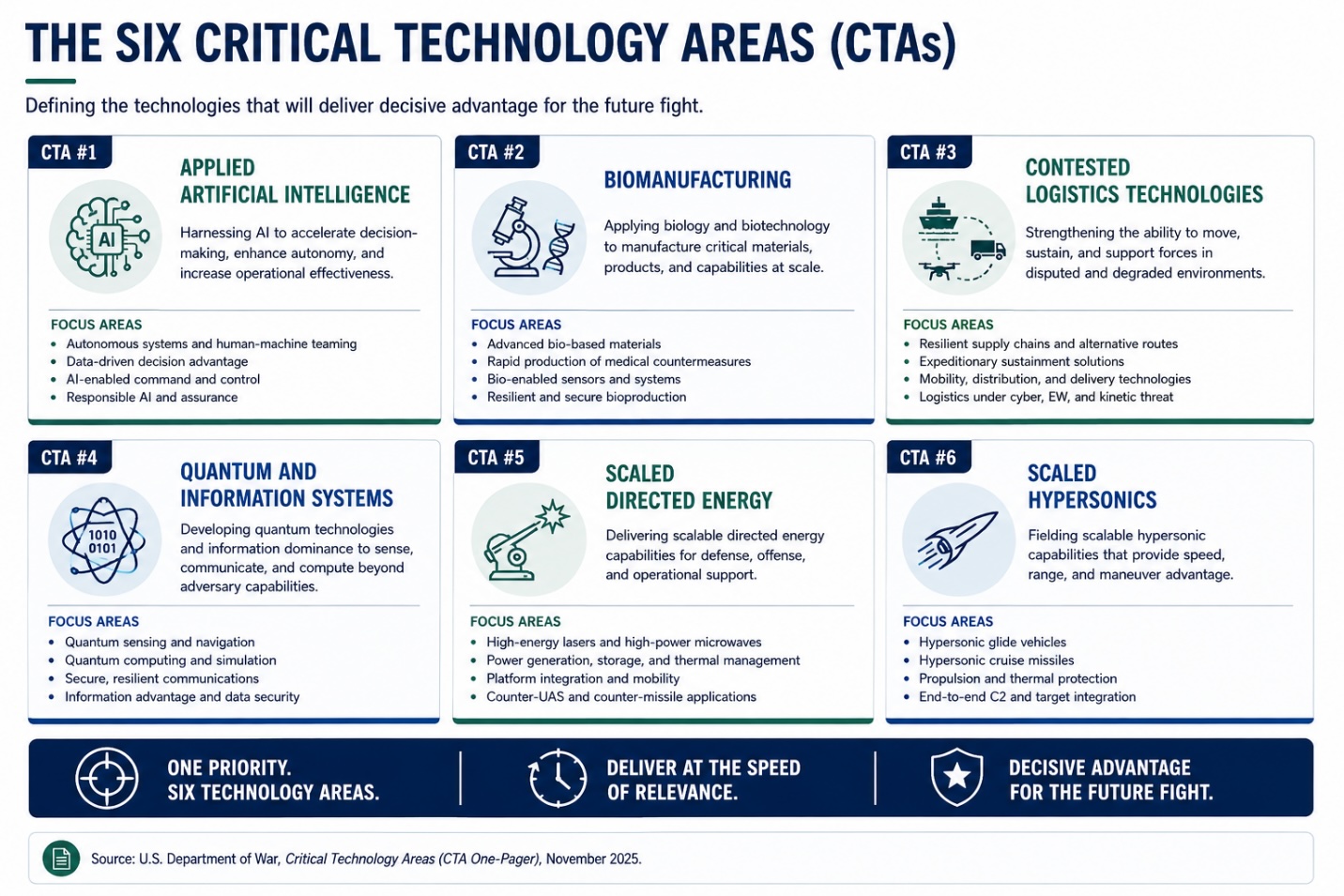
In summary, we believe these commitments point to a longer, more in-depth defense cycle increasingly shaped by technology, industrial capacity, and multi-year modernization. For investors, that expands the discussion beyond traditional military platforms and toward the systems, data, supply chains, and infrastructure needed to support modern defense.
Defense Strategy is Moving from Platforms to Critical Technologies
The policy direction is becoming clearer: defense modernization is increasingly being organized around technology-driven capabilities rather than traditional platform replacement alone.
The U.S. Department of War has identified six Critical Technology Areas, or CTAs, to guide department-wide technology priorities: applied artificial intelligence, biomanufacturing, contested logistics technologies, quantum and battlefield information dominance, scaled directed energy, and scaled hypersonics. They reflect how the department is thinking about future military advantage.
Applied AI is being positioned around faster decision-making and operational efficiency. Contested logistics focuses on keeping forces supplied when transportation networks, ports, bases, or communications are disrupted. Quantum and battlefield information dominance points to the growing importance of sensing, computing, communications, and data security. Directed energy and hypersonics reflect the push toward speed, precision, and new forms of deterrence.10
This marks a paradigm shift away from a purely “platform-first” model of military spending. Aircraft, ships, vehicles, and missiles remain essential, but future capability increasingly depends on the systems connecting them. Data, autonomy, communications, cyber resilience, electronic warfare, and supply chain security are becoming central to how modern defense forces operate.
It also changes the opportunity set for investors. The companies positioned around these priorities are not limited to traditional prime contractors. The ecosystem increasingly includes software firms, cybersecurity providers, satellite and communications companies, advanced manufacturing businesses, AI developers, and other nontraditional vendors that can contribute specific capabilities.
That is important because the department has emphasized timeliness. The CTA framework is designed to deliver tangible results “at the speed of relevance,” with accountable senior officials overseeing development and delivery. That can create openings for companies able to move faster than traditional procurement cycles, particularly where commercial technologies can be adapted for defense use.
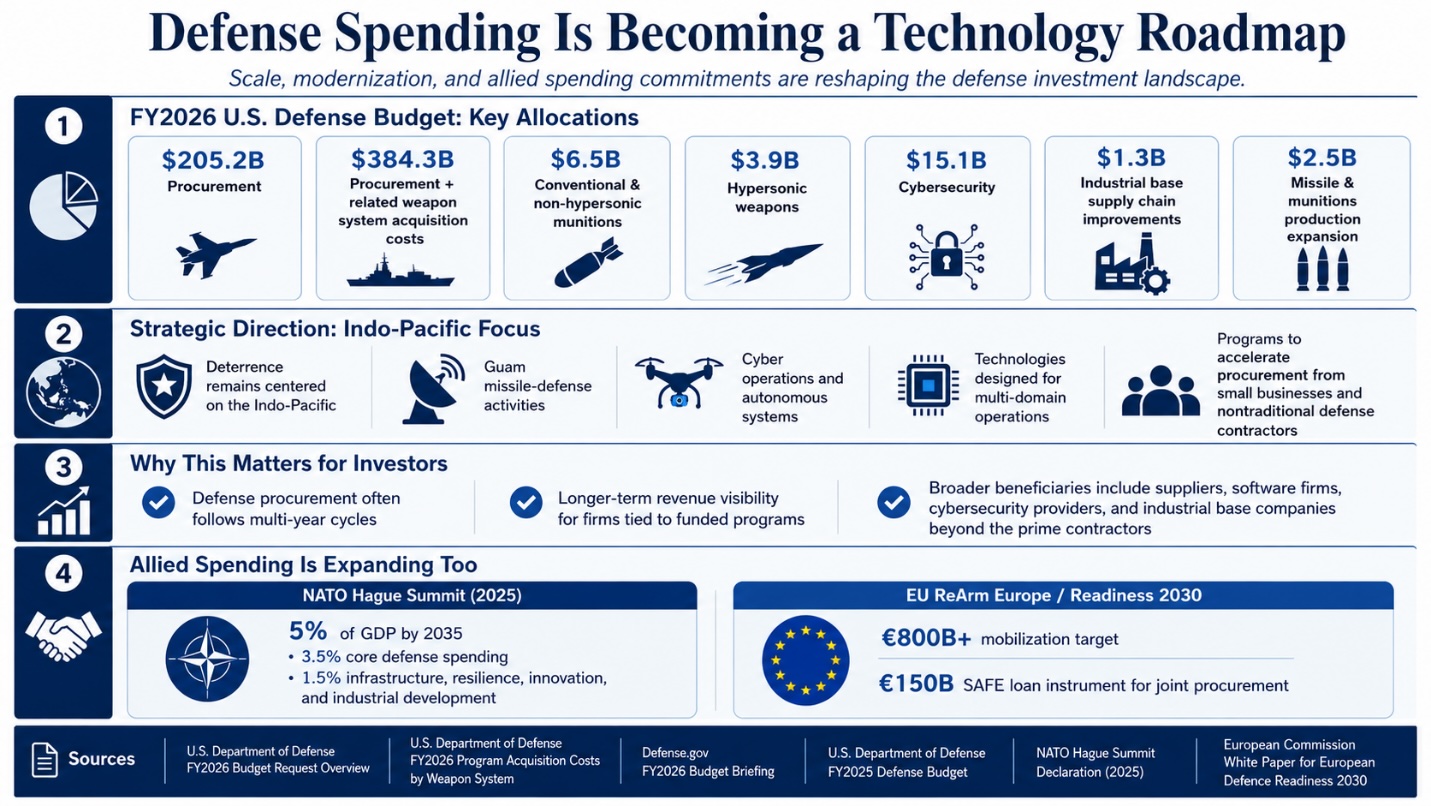
For investors, the takeaway is that defense innovation is becoming more networked and more technology driven. The future defense spending story is not just about who builds the next aircraft or ship. It is also about who provides the data layer, the autonomy stack, the secure communications, the cyber defense, and the resilient supply chain behind it.
From Defense Contractors to a Defense Ecosystem
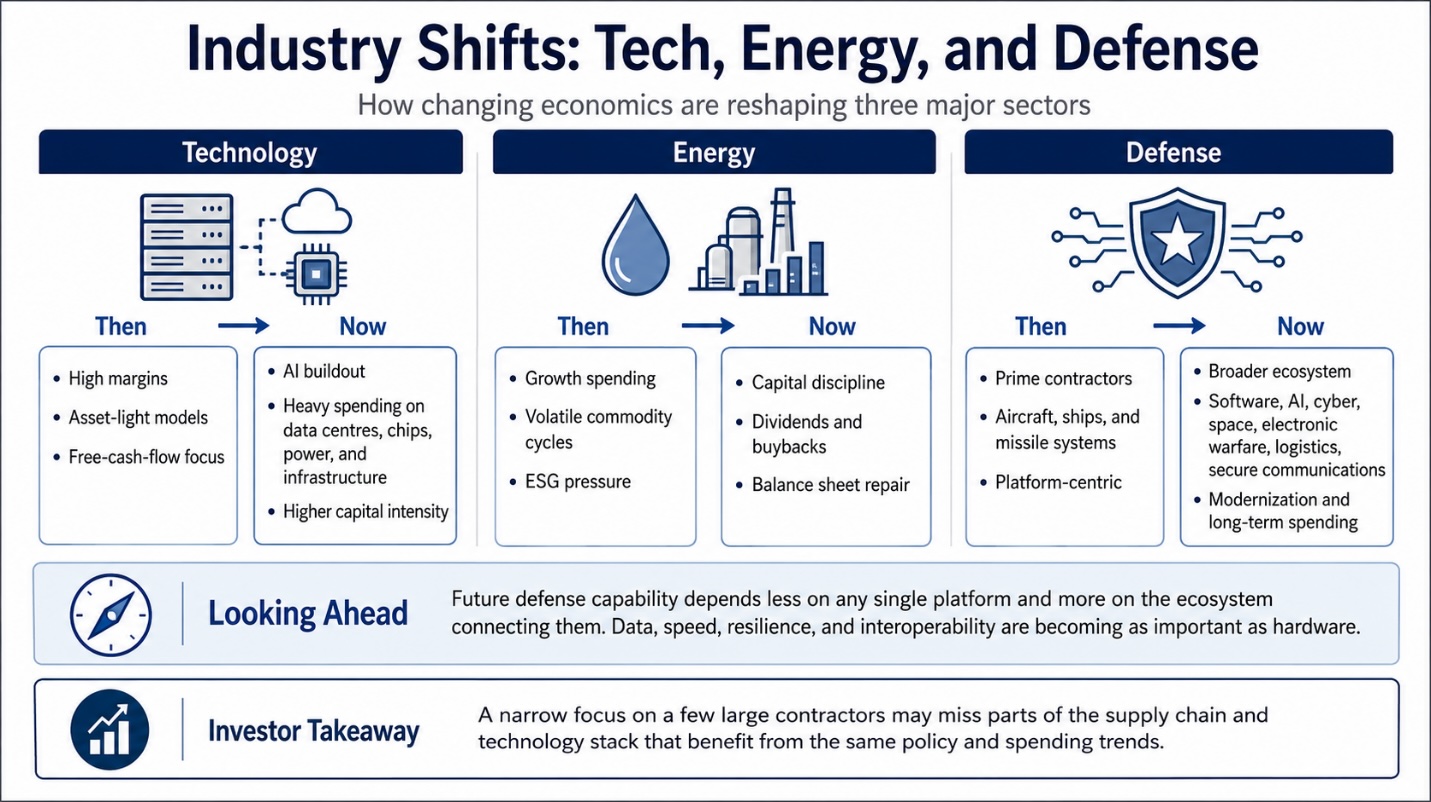
Industries change when the underlying economics change. Big tech is a useful example. For years, the sector was defined by high margins and relatively asset-light business models. The AI buildout has changed that. The largest technology companies are now spending heavily on data centres, chips, power, and infrastructure. The business model did not disappear, but the capital intensity changed.
Energy went through its own reset. After years of pressure from ESG and volatile commodity cycles, many producers shifted their focus away from aggressive growth spending and toward shareholder returns. Dividends, buybacks, and balance sheet repair became a bigger part of the investment case.
Defense appears to be going through a similar transition. The sector is no longer only about large prime contractors building aircraft, ships, and missile systems. Those companies remain central, but the opportunity set is expanding. Modern defense spending increasingly reaches into software, artificial intelligence, cybersecurity, space systems, electronic warfare, logistics, and secure communications.
That reflects how national security itself has changed. Future capability depends less on any single platform and more on the ecosystem connecting those platforms together. Data, speed, resilience, and interoperability are becoming just as important as hardware.
This fundamentally changes how defense exposure should be evaluated. A narrow focus on a few large contractors may miss parts of the supply chain and technology stack that benefit from the same policy and spending trends. At the same time, individual company risk remains meaningful, whether from program delays, cost overruns, balance sheet decisions, or contract concentration.
Defense should not be viewed only as a reaction to conflict headlines. It is increasingly tied to modernization, industrial policy, innovation, and long-term government spending. Like technology and energy before it, the sector is adapting to a new operating environment. For investors, the question is how to access that evolution thoughtfully, while recognizing both the opportunity and the risks.
Investors should consider the investment objectives, risks, charges, and expenses carefully before investing. For a prospectus or summary prospectus containing this and other information about the Fund, please call (888) 824-4467 or visit www.usdefenseetf.com. Please read the prospectus or summary prospectus carefully before investing.
For the Fund's current holdings, please visit www.usdefenseetf.com/duty
Investments involve risk, including the possible loss of principal.
Foreside Fund Services, LLC, distributor.
Sources:
https://www.darpa.mil/news/features/arpanet & https://aerospace.org/article/brief-history-gps
https://www.nato.int/en/what-we-do/deterrence-and-defence/satellite-communications
https://comptroller.war.gov/Portals/45/Documents/defbudget/FY2026/FY2026_Weapons.pdf
https://www.cto.mil/wp-content/uploads/2025/11/CTA-One-Pager-Option-Nov2025.pdf